Top
50 films of all time
(limit
one film per director) (updated January 2013) |
|
| |
1.
Viaggio in Italia
(Roberto Rossellini,
1953) |
|
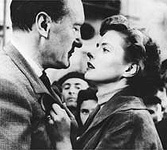 |
| An
elusive film - difficult to categorise and strange to watch. Its
levels of thematic meaning are multifarious, and its stylistics
are typically (for Rossellini) "styleless". A film about crisis
- the couple's, but also cinema's (what is cinema? what is narrative?).
An undiscovered film (despite Cahiers' praise). |
2.
Au Hasard, Balthazar
(Robert Bresson,
1966) |
|
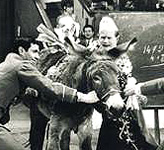 |
| A
donkey's journey - from beautiful birth, to suffering at the hands
of humans, to a lonely but peaceful death. Bresson is not Spielberg
- there is no artificial anthropomorphisation going on here. But
we certainly feel for the animal. Sharp and stylised, Balthazar
is a luminous and profound film, and incredibly moving. |
3.
Je Vous salue, Marie
(Jean-Luc Godard,
1984) |
|
 |
| Far
from blasphemous, this film is possibly Godard's sincerest and most
spiritual work. It feels like he was inspired making this film -
every nature shot is sublime, every human interaction is sweet (for
Godard), and the music (Bach and Dvorak) just soars. Directed with
a light touch, this film is a blessing. |
4.
Seventh Heaven
(Frank Borzage,
1927) |
|
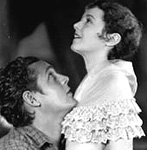 |
| The
most ambitious of Borzage's love stories featuring Gaynor and Farrell,
and the loveliest. Gaynor especially is extraordinary, whether vulnerable,
warm or distraught. Despite some tedious war sequences near the
end, Seventh Heaven is a masterpiece of transcendental love
in the face of separation. |
5.
Salò
(Pier Paolo Pasolini,
1975) |
|
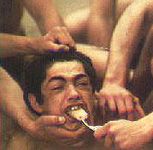 |
| An
artistic gamble, but the horror that Salò
presents is salutary. A gamble because Pasolini knew he would be
attacked by all sides, and also because it is risky throwing everything
into a film. Salutary because cinema is
too often fanciful - sometimes the images need to be harsh,
violent, shocking. |
6. Les Parapluies de Cherbourg
(Jacques Demy,
1964) |
|
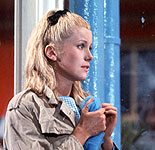 |
| A stunning formal experiment, a delightful piece of whimsy, and a profound tear-jerker all at the same time. Deneuve shines as Demy pulls out all the stops in this beautiful tale of lost love. It is Nouvelle Vague-free, but also disciplined and controlled. Of its kind, it is the original and the best. |
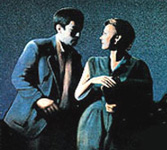
7. Toute une nuit
(Chantal Akerman,
1982) |
|
 |
| A
somewhat neglected work in Akerman's oeuvre, Toute une nuit is a singular masterpiece of experimental narrative and heightened
states of love. Far from a cold or theoretical work, the film magically
penetrates the everyday to reveal the seismic forces of passion
lurking underneath. A physically moving film.. |
8. Love Streams
(John Cassavetes, 1983) |
|
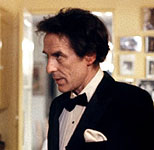 |
| In a career of many wonderful films, it is hard to choose one of Cassavetes' films above the others, but Love Streams stands out as the bravest of the films - mature, rough, loose, moving, wild, precious, and thought-provoking. It has the added poignancy of being the last (proper) film of this great actor-director. |
9.
Happy Together
(Wong Kar-wai, 1997) |
|
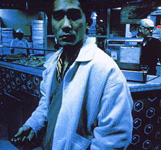 |
| Wong
uses Astor Piazzola's music as a kind of emotional glue, as fragments
of a triangle relationship disappear into the neon lights of the
strange and beautiful world Wong creates. This is a wild cinema
- low light, wide angles, sharp editing - but also a poignant cinema,
one of desire, regret, empathy. |
10.
Rush It
(Gary Youngman,
1976) |
|
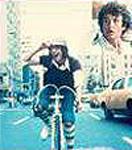 |
| A
modest but miraculous film about a New York bicycle courier (Judy
Kahan, in a great performance) who discovers love. It starts as
a feel-good portrait of urban life, with screwball touches, then
develops into a beautifully-shaded study of the emotions. Funny,
perceptive, uplifting, Rush It is an absolute joy. |
11.
L'Age d'or (Luis Buñuel, 1930)
12.
Identificazione di una donna (Michelangelo Antonioni, 1982)
13.
La Règle du Jeu (Jean
Renoir, 1939)
14. Elle a passé tant d'heures sous les sunlights ... (Philippe Garrel, XXXX)
15. Tokyo
Story (Yasujiro Ozu, 1953)
16. Le
maman et la putan (Jean Eustache,
1973)
17.
Le rayon vert
(Eric Rohmer, 1986)
18. Gertrud
(Carl Dreyer, 1964)
19. It's
a Wonderful Life
(Frank Capra, 1946)
20. Taste Of Cherry
(Abbas Kiarostami, 1998)
21. Celine et Julie
vont en bateau (Jacques
Rivette, 1974)
22. Peter Ibbetson
(Henry Hathaway, 1935)
23. Le Plaisir
(Max Ophüls,
1951)
24. Punch-Drunk Love
(PT Anderson, XXXX)
25. Vertigo
(Alfred Hitchcock, 1958)
26.
L'Oeil du malin
(Claude Chabrol, 1962)
27.
The Railway Children (Lionel
Jeffries, 1970)
28. Make Way For
Tomorrow (Leo McCarey, 1937)
29.
Tombstone for Fireflies
(Isao Takahata, 1987)
30.
Squareworld (Kenji
Onishi, 1996)
31.
The King of Comedy (Martin
Scorsese, 1983)
32. Playtime
(Jacques Tati, 1968)
33. Girlfriends
(Claudia Weill, 1978)
34. Umberto D.
(Vittorio De Sica, 1952)
35. Landscape in the Mist
(Theo Angelopoulos, XXXX)
36. The Night of
the Hunter (Charles Laughton,
1955)
37. Scorpio Rising
(Kenneth Anger, 1963)
38.
Zorn's Lemma (Hollis Frampton,
1970)
39. Christine
(Alan Clarke, 1987)
40. Family Life
(Ken Loach, 1972)
41.
Naked
(Mike Leigh, 1993)
42. Gone to Earth (Michael
Powell & Emeric Pressburger, 1950)
43. L'Atalante
(Jean Vigo, 1934)
44. La Jetée
(Chris Marker, 1962)
45.
There's Always Tomorrow
(Douglas Sirk, 1956)
46.
Tropical Malady (AAAAA, XXXX)
47.
Wavelength (Michael Snow, 1967)
48.
Alone (Stephen Dwoskin,
1963)
49.
Turnaround (Michael Lee, 1984)
50.
Twentynine Palms (Bruno Dumont, 2004)
See
also Top
50 directors of all time
|
|